
Data Centre Solar and Battery Storage Case Study | Bee Solar
See how a 1 MWp solar and 1 MWh battery system reduced electricity bills by £156k and improved PUE from 1.38 to 1.31 for a Slough data centre.
Client
Thames Valley Data Centre Ltd
Location
Slough, Berkshire
System Size
1 MWp / 1 MWh BESS
Completed
2024
Proven ROI and Operational Resilience on a Constrained Hyperscale Roof
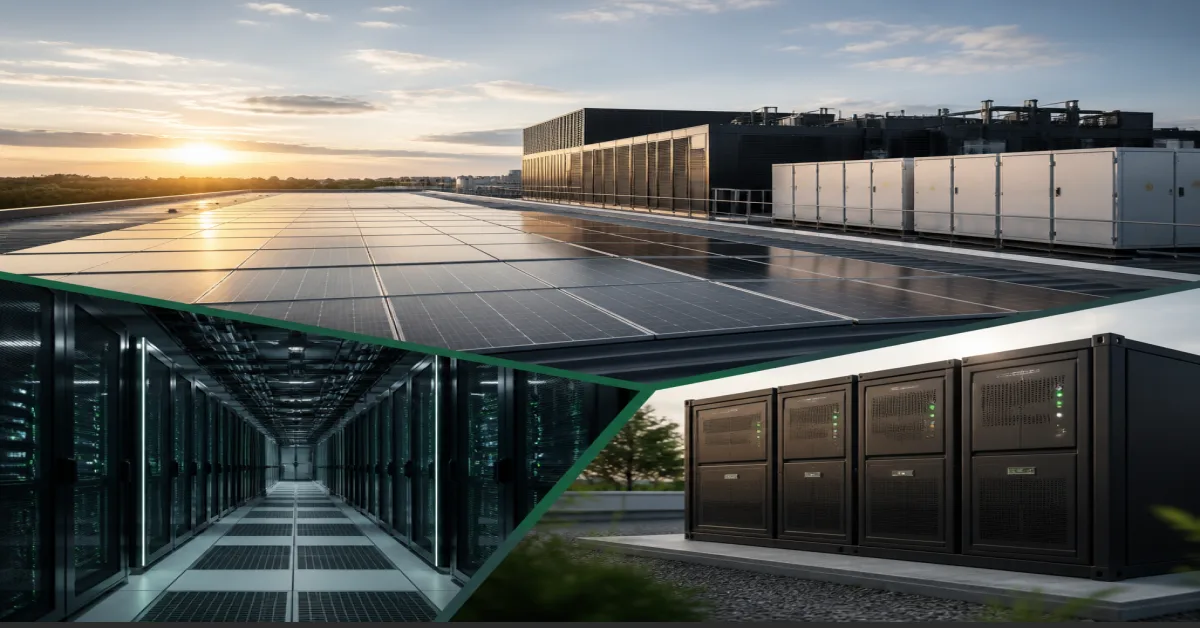
Thames Valley Data Centre Ltd in Slough, Berkshire, completed a 1 MWp rooftop solar array paired with a 1 MWh lithium iron phosphate (LFP) battery storage system in 2024, delivered by Bee Solar. This installation was engineered around two commercial outcomes: cutting operational energy costs and hardening resilience, not chasing energy independence. It represents a practical application of solar and BESS for live data centres that demonstrates how critical infrastructure can adopt renewable generation without compromising uptime.
The facility's annual electricity spend exceeded £1.2 million, with cooling representing 38% of total load. That cooling share made solar-plus-storage financially viable. The case matters for Operations Directors and Facilities Managers because it demonstrates measurable PUE improvement and cost reduction on a live hyperscale site, not a theoretical model. This is a working example of how a UK data centre can address rising power costs while maintaining the supply integrity that critical infrastructure demands.
- Client: Thames Valley Data Centre Ltd — Slough, Berkshire (provider: Manchester, Greater Manchester, UK)
- System size: 1 MWp rooftop PV + 1 MWh LFP battery — Completion: 2024
- Honest cap: Offsets 55% of daytime cooling demand, not full IT load
If your site faces similar cooling loads and peak charges, the next step is a free site survey to establish whether your roof and load profile fit this model. The financial case here rested on a specific cooling-load share, so a survey first is essential before assuming the same outcomes apply to a different facility.
HVAC-Obstructed Roof: LiDAR Drone Survey and 3D CAD Layout
Bee Solar used a LiDAR drone survey followed by a 3D CAD layout to design around the HVAC plant that covered the roof, recovering 75% usable area for the 1 MWp array.
The roof was densely occupied with chillers, evaporative cooling towers, and exhaust ducting. A standard ground-mount or simple ballasted arrangement would have failed. The solution was elevated mounting frames designed structurally to sit above the HVAC equipment, preserving plant access and airflow while carrying the PV array. This approach turned a supposedly unworkable roof into a high-capacity generation asset.
LiDAR drone survey
Captured precise roof geometry and obstruction positions.
3D CAD clash detection
Mapped array rows against chiller and ducting locations.
Elevated mounting frames
Raised the array above live HVAC plant.
75% area recovered
Previously unusable roof area recovered for the 1 MWp array.
The engineering objective was directly tied to cooling-load offset and PUE improvement. Working above live HVAC plant implied strict disruption planning, and the elevated frame design protected both the array and the operational equipment beneath it. Maintenance teams retained access to the chillers and cooling towers below, which was a non-negotiable requirement for a facility running 24/7 critical operations.
EMS Architecture: 40% Emergency Reserve vs 60% Peak Shaving
The energy management system (EMS) on this project isolates 40% of the 1 MWh LFP battery as emergency reserve and cycles the remaining 60% for daily peak shaving. This split is a deliberate operating policy, not a default setting, designed to balance commercial return against resilience requirements. The system configuration adheres to UK grid compliance and connection standards, ensuring the islanding capability and grid interaction meet regulatory expectations for commercial installations.
60% daily peak shaving
Battery discharge during peak demand periods cut peak demand charges by 42%. The 60% cycling portion is sized to target the facility's highest tariff windows each day.
40% emergency reserve
- A dedicated reserve is held for grid loss or supply interruption, extending UPS bridge time from 10 minutes to 62 minutes.
- UPS companion: The BESS works alongside existing UPS, buying time for generators or controlled shutdown, not replacing them.
Solar-only would not have delivered the peak-charge reduction or the extended bridge time this project required. A PV array alone exports during the day but cannot shave evening peaks or hold reserve capacity. The 40/60 EMS split is the operating policy that makes the battery commercially and operationally useful. The BESS does not replace generators, and no generator specification changes were part of this installation.
Sub-20ms Grid-Island Transfer and Power Quality
The system was integrated via a seamless islanding inverter with sub-20ms grid-island transfer.
Why transfer speed matters
Transfer speed matters because a data centre cannot tolerate interruption during a grid event. The sub-20ms transfer allows the BESS to take over before UPS systems are stressed, maintaining continuity without introducing power quality risk. In the first 18 months of operation, the installation recorded zero power quality events. This positions the architecture as a UPS-bridge extension and PQ risk control, not an off-grid independence claim.
Before and After Results: PUE, Costs, and 312 Tonnes CO2e
The installation improved PUE from 1.38 to 1.31, reduced annual electricity costs by £156,000 (13%), and cut carbon emissions by 312 tonnes CO2e annually. These measured outcomes were validated through ongoing system monitoring and performance verification, which tracks real-world generation data against expected yield models.
PUE improved from 1.38 to 1.31
Annual electricity bill: −£156,000 (13% reduction)
Peak demand charges: −42% via battery discharge
UPS bridge time: 10 minutes to 62 minutes
Carbon footprint: −312 tonnes CO2e annually
Daytime cooling offset: 55% — zero power quality events in 18 months
| Metric | Before | After |
|---|---|---|
| PUE | 1.38 | 1.31 |
| Annual electricity bill | Over £1.2m | −£156,000 (13% reduction) |
| Peak demand charges | Baseline | −42% via battery discharge |
| UPS bridge time | 10 minutes | 62 minutes |
| Carbon footprint | Baseline | −312 tonnes CO2e annually |
| Daytime cooling offset | N/A | 55% |
| Power quality events | N/A | Zero in first 18 months |
These results are site-specific. A different PUE baseline, roof geometry, or cooling-load share will change the outcome. Replicating this project requires a survey and design exercise, not a cloned bill of materials.
Frequently Asked Questions
Can a data centre run on solar power?
No, not on this configuration. The 1 MWp rooftop array offsets 55% of daytime cooling demand, not full IT load. Solar on this site was designed to cut energy cost and improve PUE, not to island the facility from the grid. The remaining daytime cooling load and all IT load continue to draw from the grid, which is why the system is positioned as a cost and efficiency measure rather than a generation replacement.
Why pair battery storage with data centre solar instead of solar only?
Solar alone cannot shave peak demand charges after dark or provide emergency reserve. The 1 MWh LFP battery in this project delivers a 42% cut in peak demand charges and extends UPS bridge time from 10 to 62 minutes. Solar-only would achieve neither, as PV generation stops at sunset when many peak tariff windows begin.
Is UPS plus generators enough without BESS?
UPS plus generators covers short-term ride-through and long-term backup, but it does not reduce peak demand charges or improve PUE. The BESS here acts as a companion to existing UPS, extending bridge time from 10 to 62 minutes while cycling 60% of capacity daily for peak shaving. Generators remain in place untouched.
Can rooftop solar work when HVAC plant occupies most of the roof?
Yes. A LiDAR drone survey and 3D CAD layout allowed elevated mounting frames to be designed above chillers, evaporative cooling towers, and exhaust ducting. This recovered 75% of the roof area for the 1 MWp array on this project. The elevated frames maintain plant access and airflow, so the HVAC equipment continues to operate normally beneath the array.
Does this mean energy independence for the facility?
No. The system offsets 55% of daytime cooling demand and provides a 62-minute UPS bridge, but the facility remains grid-connected. Energy independence was not the objective; reducing cost, improving PUE from 1.38 to 1.31, and cutting peak charges were. The grid remains the primary power source, with the BESS providing targeted resilience and cost control.
Want Results Like This?
Every project starts with a free site survey. Let us show you what solar can do for your building.