
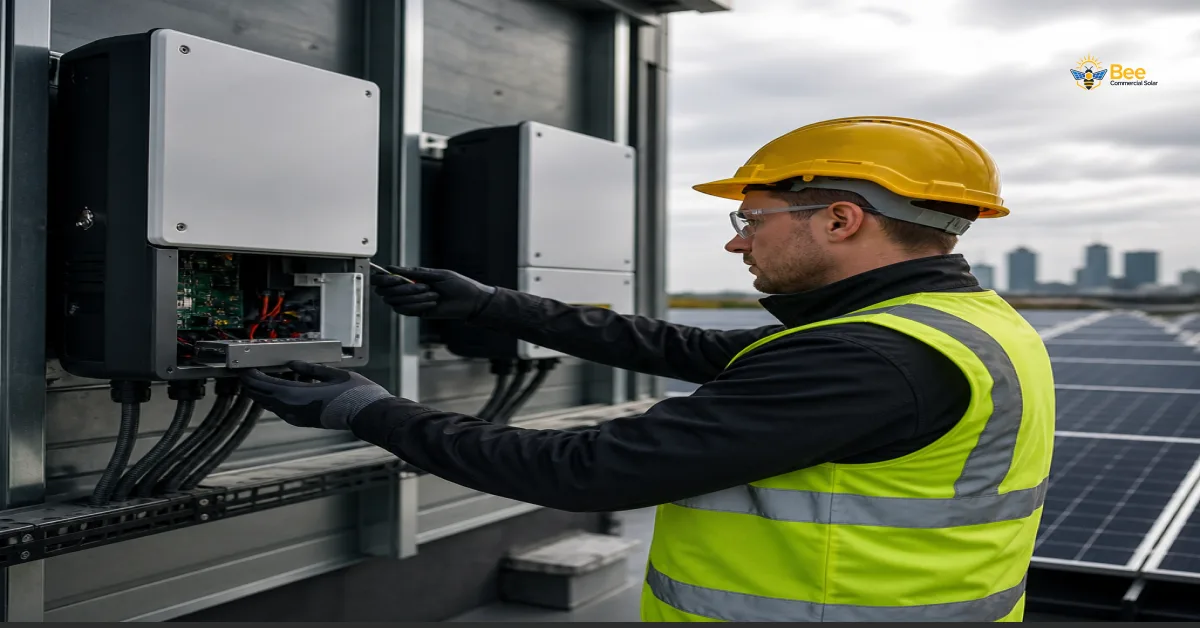
Solar Inverter Replacement Manchester
Commercial inverter replacement that restores lost output. Survey, swap and recommissioning.
What's Covered on This Page
- Warning Signs of Silent Revenue Loss on Manchester Commercial Solar
- Why Manchester Commercial Inverters Fail Earlier Than Rated Life
- Replace Like-for-Like or Upgrade to a Hybrid Inverter
- Commercial Inverter Replacement Process, Downtime and DNO in Greater Manchester
- Choosing a Qualified Inverter Replacement Specialist in Manchester
- Frequently Asked Questions
Need Solar Panel Inverter Replacement Manchester?
0161 570 0596
Get A Free Quote. Bee Solar is ready to help.
Warning Signs of Silent Revenue Loss on Manchester Commercial Solar
Commercial inverters often keep running while converting less DC to AC, so sites can limp at 60–70% capacity for months. This is partial failure, and it is a generation-revenue loss, not a “broken box” that stops working. The loss is invisible from the ground because the panels are still producing DC and the inverter is still showing a green light.
Watch for these warning signs in priority order:
- Dropping yields: generation slips 10–15% with no change in panels or weather. Compare monthly kWh against the same month last year rather than relying on seasonal averages.
- Error codes or fault lights: red or amber indicators, flashing codes, or a unit that goes dark. A fault light that clears itself and returns is still a fault that needs diagnosis.
- Unusual buzzing or clicking: louder hum or intermittent clicks from internal components. Audible changes often precede capacitor or fan failure.
- Frequent tripping: the inverter shuts down and restarts on its own, common on older units in Ancoats and the Northern Quarter where buildings run heavier loads and the local distribution network has less headroom.
- Monitoring gaps: blank periods or inconsistent data on the dashboard as the inverter drops offline. If the monitoring portal shows gaps around midday, the unit is likely overheating or clipping.
A typical scenario: a warehouse manager in Manchester sees the electricity bill creep up over a quarter. The panels look fine from the ground. The inverter has been underperforming since spring, silently costing hundreds of pounds in lost generation. By autumn, if the fault is clipping at peak sun hours, the loss can reach into the thousands before anyone opens the monitoring dashboard.
Commercial solar system monitoring is the defence. A configured dashboard catches output dips, fault codes, and brief offline periods before they become a full quarter of revenue damage. Monitoring also provides the historical data an engineer needs to diagnose whether the issue is the inverter or something upstream in the array.
If this sounds familiar, don’t wait for a total shutdown. A diagnostic visit confirms whether you need replacement or repair. Call 01615700596 for a free site survey and diagnostic.
| Warning Sign | What You See | What It Means |
|---|---|---|
| Dropping yields | 10–15% slip vs same month last year | Likely partial failure / clipping |
| Error codes | Red / amber lights, flashing codes | Active fault needing diagnosis |
| Buzzing / clicking | Louder hum, intermittent clicks | Capacitor or fan failure ahead |
| Frequent tripping | Shutdowns and auto-restarts | Overload / grid instability stress |
| Monitoring gaps | Blank midday periods | Overheating or offline unit |
Why Manchester Commercial Inverters Fail Earlier Than Rated Life
Many commercial rooftop units in Manchester fail at seven or eight years despite 10–15-year ratings. It is a pattern, not a fluke. The rated life assumes controlled temperature and humidity, which is not what commercial rooftops and plant rooms in Manchester deliver.
Common causes found on commercial sites:
- Moisture ingress from poor sealing or plant-room ventilation issues. Condensation inside the enclosure attacks PCBs and connectors.
- Dust and debris buildup restricting airflow around cooling fans. Once a fan stalls, internal temperatures rise and accelerate component wear.
- Thermal cycling from cool mornings to warm afternoons, straining solder joints. Manchester’s spring and autumn temperature swings are worse for electronics than a consistently hot climate.
- Capacitor degradation in moisture-heavy air. Electrolytic capacitors dry out faster when humidity and heat combine.
- Voltage fluctuations from grid instability in older parts of the local distribution network. Spikes and sags stress the inverter’s input stages.
- Undersized inverters running at peak capacity for years with no headroom. A unit sized at the edge of its rating has no tolerance for derating as components age.
This is why a warehouse roof in Trafford Park or a commercial unit near Ancoats can fail early. Trafford Park sites often have units in unventilated plant rooms next to heat sources. Ancoats buildings on older distribution infrastructure see more voltage variation. The original installer walked away, and nobody checked the inverter again until generation figures dropped.
Humidity and thermal cycling stress power electronics, not the panels. The panels and wiring can be fine while the inverter throttles output or clips during peak sun hours. When a site is losing output, the inverter should be the first suspect, not the last.
For more in-depth analysis on protecting your assets from these common failure points, you can explore our commercial solar insights hub.
Moisture & Dust
Condensation and blocked fans drive early capacitor and PCB failure.
Thermal Cycling
Cool mornings to warm afternoons strain solder joints and components.
Grid & Sizing Stress
Voltage variation plus undersized units with no headroom shortens life.
Replace Like-for-Like or Upgrade to a Hybrid Inverter
A hybrid inverter still converts DC to AC and also manages battery charging and discharging. The difference is that a standard inverter only exports to the grid, while a hybrid can hold energy for later use.
Peak-Rate Savings
Use stored energy on peak rates instead of exporting at a low tariff. Automatic charge and discharge plus smart load management. Model savings with our commercial solar ROI calculator.
Backup for Critical Loads
Backup power for refrigeration, servers and security. See how solar and battery systems for data centres protect critical operations.
Surveyed & Future-Ready
Our MCS-certified team assesses array, DNO connection and cabling. Future readiness for time-of-use tariffs. Hybrid inverter with battery storage makes sense when you can use stored energy.
Peak electricity rates in the UK can be 30–40% higher than off-peak. If you are replacing anyway, the incremental hybrid cost is often recovered in two to three years through peak-rate savings alone. This is site-dependent typical commercial reasoning, not an independently audited figure.
Hybrid is not for every site. It is not worth specifying if you have no storage plan, the connection or cabling cannot support it, or the survey shows a mismatch with the existing array. For real-world proof of this resilience, see a hospital solar and battery case study where backup power was critical, or solar and battery for cold storage in Manchester to see how refrigeration loads were protected.
Commercial Inverter Replacement Process, Downtime and DNO in Greater Manchester
A typical replacement takes three to five hours for a single commercial inverter. Larger systems or access-constrained plant rooms may need a full day. The aim is to restore generation the same day.
Assessment
Inspect unit, check error codes, review monitoring data. Mirrors a commercial energy audit case study.
System Design Check
Recalculate string voltages because panels degrade; match inverter to current output.
Isolation & Disconnection
Lock off DC and AC sides, remove old unit and replace deteriorated isolators.
Mounting & Wiring
Connect DC strings, wire AC output, check every termination to correct torque.
Commissioning & DNO
Power up, run diagnostics, handle G98/G99 notification with Electricity North West.
Handover & Monitoring
Display walkthrough, monitoring connection, commissioning sheet and photos.
The system is offline during isolation. That is unavoidable, so replacements are scheduled around operations. Most commercial sites accept a morning slot so the system is back online by early afternoon.
Replacement is an array re-match, not a simple box swap. Getting the sizing wrong costs generation. A new inverter matched to the current output of your degraded panels will perform better than a like-for-like swap using the original specification.
Choosing a Qualified Inverter Replacement Specialist in Manchester
Grid-tied commercial inverter work is DC electrics, isolation, and DNO compliance, not a generic electrical job. DIY is not appropriate for commercial grid-tied systems. A general electrician can change a consumer unit safely, but that does not qualify them to size an inverter to a degraded array or manage G99 applications.
Checklist in priority order:
- MCS certification: non-negotiable for grid-connected UK solar work.
- Commercial-scale experience: a 50kW array in Trafford Park behaves differently to a 4kW domestic setup.
- Three-phase and HV DC isolation competence: string configurations and three-phase balancing matter at 600V DC or higher.
- G98/G99 compliance knowledge: the installer handles DNO approval before the swap, not after.
- Hardware and array matching: wrong sizing kills output.
- Monitoring reconfiguration: the dashboard must be reconnected and verified after the swap.
Ask direct questions before booking: How many inverter replacements have you done this year? Can you provide G99 documentation if needed? Will you reconfigure the monitoring after the swap? Reviewing our recent commercial solar projects can give you a sense of the scale and complexity we handle.
Local knowledge matters. Electricity North West contacts and approval timelines vary across districts. A local team already knows the relevant DNO contacts, which saves weeks of waiting.
A cheap general electrical contractor may quote less, but the risk is tripping or export drop six months later. Our team carries full MCS accreditation and has completed commercial inverter replacements across Manchester for years. Call 01615700596 for a free site survey, with no obligation and a response within 24 hours.
Frequently Asked Questions
Common Questions About Solar Inverter Replacement in Manchester
How long does a solar panel inverter replacement take on a commercial site in Manchester?
Most commercial inverter replacements in Manchester are completed within a single day. A straightforward swap on a standard rooftop unit usually takes three to five hours. Larger systems or access challenges like plant rooms in older buildings may need a full day. The aim is to get the system back online and generating the same day.
Will my solar system generate during the inverter replacement?
No. The system will be offline while the inverter is replaced because it must be fully isolated before removal. For most Manchester commercial sites, this means a few hours of downtime. Jobs are scheduled to minimise impact on busy operating hours, and the system is verified as generating correctly before the team leaves.
My inverter is only seven or eight years old — can it already be failing in Manchester?
Yes. It is more common in Manchester than most people expect. High humidity, frequent temperature swings, and damp conditions accelerate wear on inverter electronics. Capacitors degrade faster in moist air, which is why units on commercial rooftops in Trafford Park and Ancoats often fail within their rated lifespan. If generation figures are slipping, get it checked rather than waiting for a full shutdown.
Can a failing inverter reduce output without stopping completely?
Yes. An inverter can partially fail and keep running at 60–70% capacity for months. Panels look fine from the ground, but generation revenue is lost every week. If bills are creeping up and generation figures do not match expectations, a partial inverter failure is worth ruling out first.
Can I replace a grid-tied commercial solar inverter myself?
No. Grid-tied commercial inverter work involves DC electrics, isolation procedures, and DNO compliance. DIY is not appropriate because the risks include electric shock, fire from loose terminations, invalidating warranties, and failing DNO notification requirements. This is specialist work for an MCS-certified commercial installer.
Should I repair or replace a commercial solar inverter?
A diagnostic visit determines this. Repair is possible for some faults, but partial failure combined with age and environmental stress often favours replacement. If the inverter is seven or eight years old in Manchester and exposed to humidity and thermal cycling, replacement is usually more cost-effective than repair because other internal components are likely degraded too.
Do I need to notify the DNO (Electricity North West) before replacing a commercial inverter in Manchester?
Your installer handles the DNO notification as part of the process. For commercial sites in Manchester, this is standard practice when disconnecting and reconnecting grid-tied equipment. The installer manages G98/G99 registration, but it is worth checking whether the original system was registered correctly, as some older commercial installations have documentation gaps.
What should I have ready before the engineer arrives?
Confirm access to the inverter location, whether plant room, roof hatch, or external enclosure. If the system has a monitoring portal, have log-in details ready so historical generation data can be reviewed before work starts. Any previous fault codes or error logs are useful. For multi-tenant buildings or managed estates, sort access permissions in advance. Also check any maintenance records for the array, as string test results help the engineer confirm the design check.
What affects the cost of commercial solar panel inverter replacement in Manchester (without published prices)?
Cost depends on system size, three-phase requirements, access constraints, whether you choose a standard or hybrid inverter, isolator replacement needs, and DNO notification requirements. Array size and string configuration determine the inverter specification required. Access constraints, such as difficult roof access or confined plant rooms, add labour time. The only way to get an accurate figure is a site survey. Call 01615700596 to arrange a free, no-obligation survey and receive a quote based on your specific site.
Is a hybrid inverter worth specifying if we are replacing anyway?
It is worth specifying if your site can use stored energy on peak rates and the connection or cabling supports it. The incremental cost over a standard inverter is often recovered within two to three years through peak-rate savings, based on the UK peak/off-peak differential of 30–40%. If there is no storage plan or the connection cannot support it, a like-for-like replacement is the sensible choice.
Ready to restore your generation and stop silent revenue loss? Request your free site survey today. Call 01615700596 now.
Get Your Free Solar Quote
Our engineers will visit your site for a free survey and deliver a detailed proposal within 48 hours.
0161 570 0596
No obligation. Response within 24 hours.