
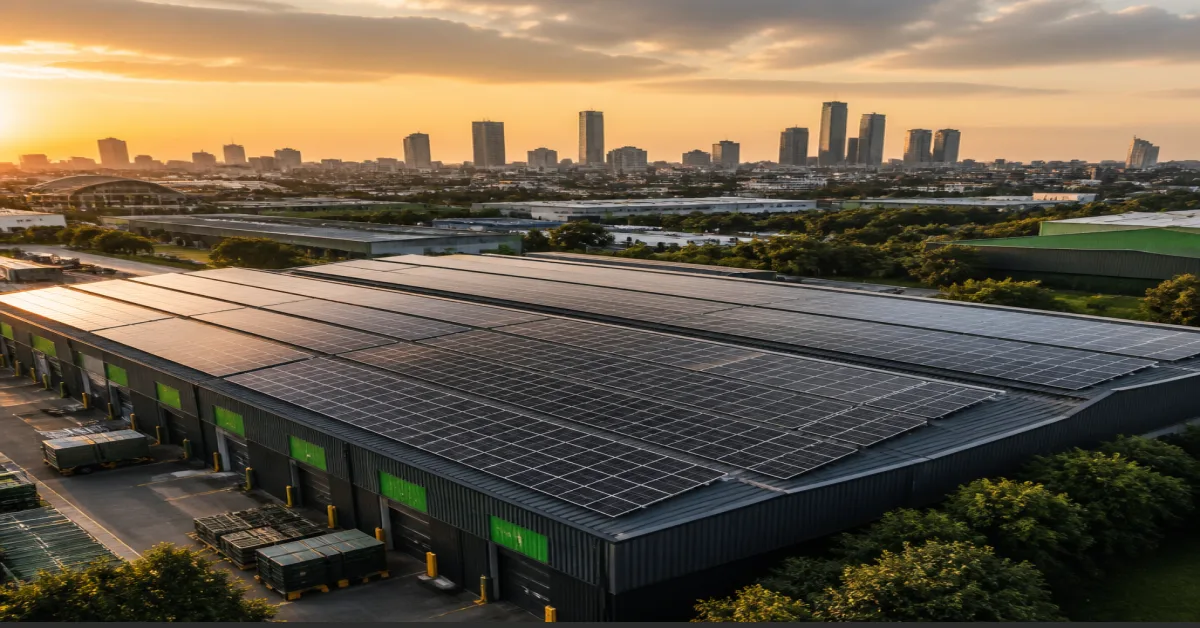
Factory Solar Panels Manchester | Bee Solar
Cut factory energy costs 30–50% with rooftop solar sized to your shift load. Free survey.
30–50%
Typical year-one bill cut
4–6 yr
Typical factory payback
200kW+
Trafford Park-scale roof potential
8–14 wks
Survey to switch-on
What's Covered on This Page
- Why Manchester Factories Are Switching to Solar Now
- How Factory Roof Type and Building Age Affect Your Solar Options
- What Your Factory Can Expect to Save and When
- Combining Solar with EV Charging on Your Factory Site
- The Installation Process: From Site Survey to Switch-On
- Frequently Asked Questions
- Book a Factory Roof Survey in Greater Manchester
Why Manchester Factories Are Switching to Solar Now
Manufacturing sites face some of the highest industrial electricity costs in the UK, and rooftop solar is now used to slash peak demand charges and daytime grid spend, not as a generic green slogan. We have observed contract increases of 40 to 60 per cent on some factory energy contracts we have reviewed, which is why unused roofs across Trafford Park and the Greater Manchester industrial belt are now seen as a financial asset rather than just a weatherproofing liability.
Daytime heavy-machinery load profiles on factory sites self-consume most of the generation, which is why typical UK commercial payback runs at five to seven years, and is often shorter for energy-intensive plants when tied to roof, load, and self-consumption variables. Year-one bill cuts of 30 to 50 per cent are typical in our experience, but never guaranteed. The financial stack that makes this work today includes Capital Allowances, which allow the full cost to be offset against taxable profits in the first year under current rules, business rates relief on rooftop solar, and the Smart Export Guarantee for surplus power.
Capital Allowances
Full cost against taxable profits in the first year – confirm with your accountant.
Business Rates Relief
Rooftop solar is excluded from rateable value.
Smart Export Guarantee (SEG)
Paid for surplus generation exported to the grid.
Daytime Load Match
Peak demand coincides with maximum solar output for maximum self-consumption.
Many owners only see the significance of their daytime load profile once half-hourly data is mapped against peak and capacity charges, not annual kWh averages. The difference between a factory and an office is that a factory’s peak demand often coincides with maximum solar output, which is what makes the financial case so strong. The Electricity North West (DNO) connection process is becoming more predictable, and we handle the application as part of the project. Every quarter without on-site generation is grid-rate electricity that could have been produced on the roof. For factories with specific temperature-controlled needs, solar for cold storage sites follows the same high daytime load principles.
Call 0161 570 0596 to book a free factory roof survey with Bee Commercial Solar.
How Factory Roof Type and Building Age Affect Your Solar Options
Roof material and structure decide the mounting method, programme risk, and whether panels can be fixed without voiding the weatherproofing.
| Roof Material | Typical Manchester Stock | Mounting Solution |
|---|---|---|
| Profiled metal | Common Trafford Park industrial units | Clamp to standing seams or ribs; no sheet penetration |
| Flat felt or single-ply | Newer buildings and extensions | Ballasted frames or bonded mounts; membrane stays intact |
| Composite insulated panels | Post-2000s construction | Lightweight panels; load limits must be verified before install |
| Asbestos cement | Pre-1990s stock, e.g. Openshaw-era | No drilling; over-sheeting or honest re-roof recommendation |
A structural survey is required before any design work to confirm load-bearing capacity and map obstructions such as skylights or extraction units. The fixings themselves also matter: on profiled metal we use seam clamps that avoid penetrating the sheet, while on flat felt the entire membrane must remain intact to preserve the weatherproofing guarantee. Building age is a design factor, not an automatic refusal: a 1960s portal frame in Openshaw may need structural engineer approval because original steel specifications were lower than modern equivalents, while a 2015-rated steel building will likely handle the load with no issue. Older sites may also need a distribution board upgrade or new cable runs from the roof to the main switchboard, which is a cost to plan for rather than a blocker.
If the roof is due for replacement within about five years, combine re-roof and solar in one programme to save on scaffolding and avoid a strip-and-refit later. Misjudging material, especially asbestos and lightweight composites, causes delay and cost more often than Manchester weather; survey first, design second.
What Your Factory Can Expect to Save and When
Savings start when the system is live, but full payback depends on roof size, usage pattern, and the share of generation consumed on site, not a single advertised year. Based on our installed systems, a typical factory payback is four to six years, while UK commercial averages five to seven; heavy daytime loads can shorten this, but never guarantee a specific return without a survey.
Illustrative only: a mid-sized Trafford Park-scale system around 200 kW can offset 40 to 60 per cent of annual electricity costs, and a 500 kWp / 200 kWh Stockport-class system delivered £102k per year savings with a 55 per cent peak demand reduction for that specific system class. For a real-world example, this Manchester cold storage project shows similar operational savings in action. These are examples of installed systems, not promises for your site. The Solar Energy UK trade body indicates commercial solar returns of 10 to 20 per cent annually, with the higher end achieved when daytime self-use is high.
The main financial drivers are daylight self-consumption at peak prices, SEG on surplus (which pays less than avoided import), stable generation cost versus rising grid prices, reduced peak/capacity charges, and optional battery storage for afternoon spikes. Carbon and Scope 2 reporting is secondary, but provides tender evidence for supply-chain contracts that increasingly ask for verified emissions data. To estimate your own figures before committing, you can try our solar ROI calculator.
Factories beat offices on solar economics because production aligns with generation. Night-only or highly intermittent loads are the cases not to oversell until a survey has confirmed the load profile, because without daytime consumption the payback extends beyond the typical range. For comparison, solar for office buildings often performs differently due to lower base loads. Reviewing our commercial solar case studies can give you a clearer picture of the financial return across various sites.
Request a projection using your half-hourly data by calling 0161 570 0596.
Combining Solar with EV Charging on Your Factory Site
Adding chargers alone often increases peak demand charges, but pairing them with rooftop generation lets vans, cars, and forklifts charge from the roof during the day instead of from the grid. This is the difference between a second bill shock and a managed site load.
PV Only
Best when production load is the priority and fleet charging is not planned.
PV + EV Chargers
Use daytime generation for parked fleet; shared trenching, cabling, and switchgear cut civils cost.
PV + Battery + EV
Store surplus for overnight or early top-ups, and discharge for evening peaks.
Smart Management
Smart charge management prioritises solar over grid draw.
- PV only: Best when production load is the priority and fleet charging is not planned.
- PV + EV chargers: Use daytime generation for parked fleet; shared trenching, cabling, and switchgear cut civils cost.
- PV + battery + EV chargers: Store surplus for overnight or early top-ups, and discharge for evening peaks.
Many Trafford Park-scale roofs can support 200 kW or more of generation, which is enough to power production and a bank of chargers from one system. Smart charge management prioritises solar over grid draw, and workplace charging capital allowances are a tax talking point for your accountant, not an invented grant name. Staff charging also functions as recruitment hygiene for drivers and shift workers, though this is secondary to the operational cost case. For full specifications, see our EV charger installation details.
Chargers without solar is a common factory mistake because the site takes on a second demand peak on top of production load. Overlapping civils is the cost reason to do both in one programme, with one DNO conversation for capacity rather than two separate applications at different times. We handle PV design, the Electricity North West application, and EV installation as a single team so the electrical infrastructure is sized once, correctly.
The Installation Process: From Site Survey to Switch-On with Electricity North West
End-to-end factory solar installs typically take eight to fourteen weeks, and the Electricity North West DNO application is usually the longest step. The programme below shows how we run industrial installations around production and grid connection.
Site Survey & Structure
Roof load, obstructions, electrical infrastructure, and asbestos identification if suspected.
Design to Load Profile
Matched to half-hourly data and shift pattern, not a generic template.
DNO Application
Via Electricity North West, typically four to eight weeks.
Install
Two to three weeks on a typical Trafford Park-scale roof, coordinated around shifts.
Commissioning
System goes live and monitoring starts.
Handover & Training
Facilities training with jargon-free monitoring walkthrough.
- Site survey and structural assessment (~half a day): Roof load, obstructions, electrical infrastructure, and asbestos identification if suspected.
- Design to load profile and production schedule: Not a generic kWp-from-roof template; the design is matched to your half-hourly data and shift pattern.
- DNO application via Electricity North West (typically four to eight weeks): We file the paperwork; most roofs are still permitted development, but ENW approval is still required for grid connection.
- Install (two to three weeks on a typical Trafford Park-scale roof): Panels, inverters, and cabling routed to the main board, coordinated around shifts to avoid production downtime.
- Commissioning and grid connection: System goes live and monitoring starts.
- Handover and facilities training: Your team gets a jargon-free walkthrough of the monitoring platform.
Switch-on is gated by Electricity North West capacity and application timing, not by panel delivery, so we flag constraints at the survey stage. If your local substation is near capacity, we identify that early and advise on the options, which may include a smaller export limit or timing the application to match planned network upgrades. We also coordinate with your roofing contractor if remedial work is needed, and identify any structural reinforcement early to avoid surprises. For existing systems needing upkeep, our inverter maintenance guidance helps you protect your asset's performance.
Common mistakes we prevent: sizing to roof rather than load, installing then re-roofing, and ignoring DNO until late in the project. Call 0161 570 0596 to start the process with a site survey.
Frequently Asked Questions
Frequently Asked Questions
Does my Manchester factory need planning permission for solar panels?
Most factory solar installations in Manchester qualify as permitted development, so you do not need a full planning application in the majority of cases. Exceptions include listed buildings and sites in conservation areas, which we confirm during the initial site survey. We still manage the DNO application with Electricity North West on your behalf, and we confirm your permitted development status before any design work begins.
My factory roof has asbestos cement sheets — can I still get solar installed?
Yes, but drilling directly into asbestos cement is not permitted. We use over-sheeting solutions that sit above the existing roof without penetrating it, which is a common scenario on older Manchester factories built before the 1990s, particularly around Openshaw. We identify asbestos during the structural survey and adjust the mounting design accordingly. In some cases where the asbestos roof is near end of life, we will honestly recommend a re-roof before solar rather than over-sheeting a failing substrate.
How long does a factory solar installation take from first contact to switch-on?
From initial site survey to switch-on, most Manchester factory installations take between eight and fourteen weeks. The DNO application with Electricity North West is usually the longest single step at four to eight weeks, with design and on-site installation taking two to three weeks depending on system size. The survey itself takes around half a day.
Will solar panels actually make a difference to a factory running heavy machinery?
Yes, factories are a better fit for solar than offices. Heavy machinery running during daylight hours means you self-consume most of the power you generate, which offsets grid electricity at peak prices. We have seen factories cut electricity bills by 30 to 50 per cent from year one, with the exact figure depending on roof, load, and self-consumption. The key is mapping your half-hourly data so the system is sized to your actual demand curve, not an annual average.
What happens to solar power my factory generates but does not use?
Surplus electricity is exported to the grid and you receive payment through the Smart Export Guarantee. The rate is lower than what you save by self-consuming, so we always design the system to maximise on-site use first. Battery storage is an option for factories with uneven demand across shifts, allowing you to store midday generation for evening use rather than exporting it at a lower rate.
Can my factory claim tax relief on a solar installation?
Yes. Capital allowances let your business offset the full cost of a solar installation against taxable profits in the first year under current rules. Business rates relief on rooftop solar also remains in effect, and workplace EV charging attracts its own capital allowance treatment. We recommend speaking with your accountant about how these apply to your specific situation, as the interaction between allowances and any grant funding can affect the calculation.
Should we buy panels direct from a manufacturer or use a turnkey Manchester installer?
Buying panels direct leaves you to manage structural design, DNO application, MCS installation, warranties, and production coordination yourself. A turnkey installer handles all of it as one accountable package, which is usually the lower-risk route for a factory that needs to keep production running. A single pallet of panels does not connect itself to the grid, and the DNO process requires technical documentation that manufacturers do not provide. If one component fails, a turnkey contract gives you a single point of recourse rather than chasing multiple suppliers.
What is the best panel type for an industrial roof?
The best panel is the one matched to your roof structure, load profile, and daytime self-consumption, not a single brand winner. A factory with a heavy daytime load and a strong roof may benefit from higher-efficiency panels to maximise generation from limited roof area, while a site with more roof than load can use standard commercial panels to lower cost per watt. Your survey and design phase will confirm the right specification based on structural load limits, available roof area, and your financial objectives.
Do I need a battery as well as solar to cut peak demand charges?
Not always. If your peak demand spikes occur during daylight hours when the solar is generating, panels alone can cut them. If your spikes hit later in the afternoon or early evening after generation drops, battery storage is what discharges to level the load. The decision is made from your half-hourly data, not a rule of thumb. A battery also provides resilience if you are considering critical-load backup, but it adds capital cost, so we only recommend it when the data shows a clear payback.
Book a Factory Roof Survey in Greater Manchester
Bee Commercial Solar surveys the site, models savings using half-hourly data, and presents a tailored proposal with no obligation. The free site survey takes around 45 minutes, and your report is delivered within 5 business days. We cover the whole of Greater Manchester including Trafford Park, Openshaw, Stockport, Salford Quays, Wythenshawe, and the surrounding industrial estates.
Before you book, check your factory against this readiness list:
Daylight base load running during production hours
Afternoon peak or capacity charges visible on your bill
Usable roof space despite plant and ducting
3-phase electrical supply already in place
Scope 2 / ESG reporting requirements for tenders
Interest in critical-load backup from battery-backed solar
The survey is the next step because industrial quotes without roof load and Electricity North West constraints are not decision-grade. If you have night-only loads, a roof at end of life without re-roof budget, or a listed building, we will tell you honestly at the survey stage rather than selling you a system that will not meet its payback. Where issues are identified, we explain the remedial work required and what it costs before you commit. To move forward, you can book a free factory survey online.
Call 0161 570 0596 to book your free factory roof survey in Greater Manchester.
Ready to Cut Factory Energy Costs?
We will survey your factory roof, model savings from half-hourly data, and present a tailored proposal — no obligation.
Typical survey takes 45 minutes. Report delivered within 5 business days.