
Hospital Solar Panels Manchester | Bee Solar
Reinforced flat-roof solar for 24/7 clinical loads. NHS-trust experience, MCS-certified.
£92k/yr
Typical annual savings (300 kWp)
5.8 yr
Average payback with battery
98 tCO2e
Annual carbon offset
90%+
On-site self-consumption
What's Covered on This Page
- Why Manchester Hospital Buildings Suit Large-Scale Solar PV
- How Clinical Continuity Is Protected During Phased Installation
- The Hospital Solar Programme: Survey to Switch-On in Greater Manchester
- The Financial and Carbon Case for a 300 kWp Hospital System
- Solar Batteries and Estates Monitoring for Clinical Resilience
- Frequently Asked Questions
Need Solar for Hospitals?
0161 570 0596
Get A Free Quote. Bee Commercial Solar is ready to help.
Why Manchester Hospital Buildings Suit Large-Scale Solar PV
Hospital buildings across Greater Manchester are structurally and electrically better suited to solar PV than most commercial stock because of three interconnected factors: 24/7 electricity demand, reinforced plant roofs, and existing high-capacity DNO supplies that rarely become the bottleneck seen on other commercial sites.
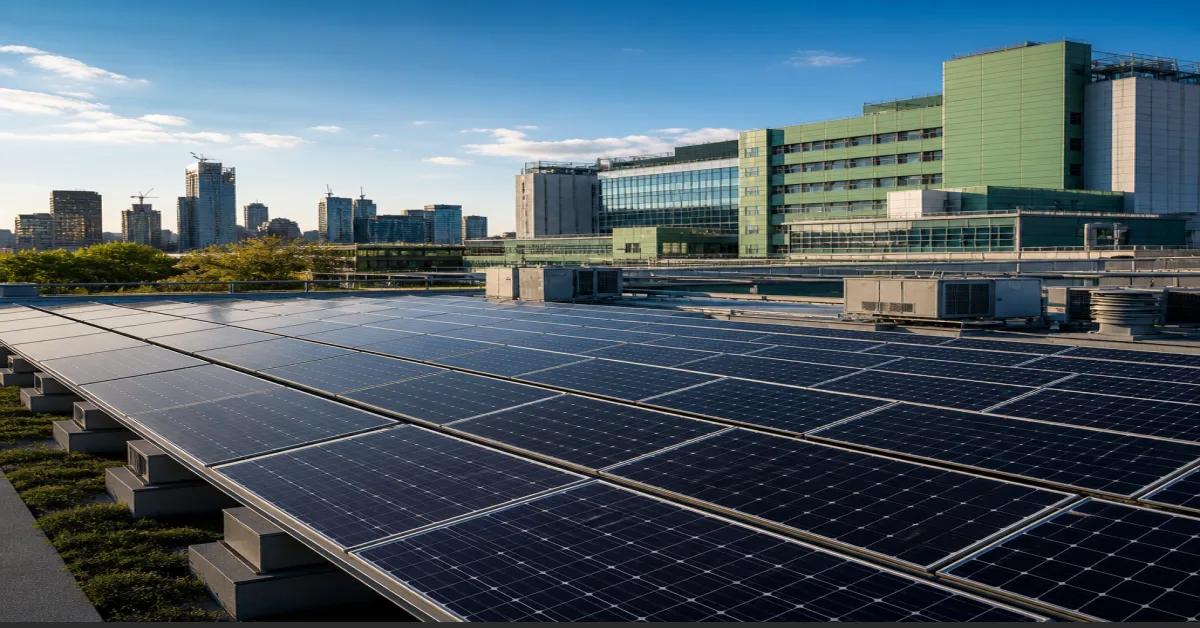
Flat roofs dominate Manchester hospital campuses. Ballasted frames mount panels at the ideal pitch without roof penetrations, which protects the waterproofing membrane and speeds up the physical installation. We have surveyed buildings in Didsbury and Fallowfield where the roof area alone could support arrays well over 200 kWp. Whalley Range-style sprawling campuses with south- and west-facing roof sections can be designed to match morning and afternoon demand peaks, so generation follows the hospital's load curve rather than an arbitrary orientation.
24/7 Load Match
Solar power is consumed on-site immediately, not exported at lower rates.
Reinforced Roofs
Built for air handling units, so load-bearing capacity is rarely the constraint.
High-Capacity Supply
Existing DNO headroom simplifies grid connection applications.
Campus Scale
Multiple buildings, car parks and walkways open canopy and ground-mount options.
The DNO advantage is the rare operational differentiator. On other Manchester commercial buildings, grid connection capacity is frequently the reason a viable solar project stalls. Hospital sites typically already have high-capacity supplies because they run theatres, imaging suites, and critical care around the clock. That headroom removes the most common hidden cost and delay.
According to the Carbon Trust, large public-sector buildings can offset up to 20% of electricity consumption with rooftop solar alone. That figure assumes good roof area and sensible orientation, both of which Manchester hospital campuses routinely offer.
Most rooftop hospital installations fall under permitted development rights for commercial buildings, avoiding a full planning application. Listed or conservation-area sites need a separate check, which we confirm at survey. For those needing more detail, our guide to commercial planning rules for solar panels is a useful reference. Ancoats-type contexts, where heritage constraints apply, are assessed on a case-by-case basis rather than assumed.
Hospital estates teams dealing with similar challenges in the hospitality sector can review how other high-occupancy buildings approach 24/7 load profiles. Our 150 kWp boutique hotel solar project demonstrates how continuous demand shapes system design for maximum self-consumption and gives suppliers direct experience with 24-hour sites.
The practical next step is an energy audit of your half-hourly meter data before any array is specified. That data determines how much of your demand profile solar can realistically cover and whether battery storage is justified. The audit also establishes your existing maximum import capacity, which shapes whether G99 applies and at what threshold.
How Clinical Continuity Is Protected During Phased Installation
Wards and theatres do not lose power during installation; continuity is an engineered programme, not a promise of a “fast” install.
Every project is broken into phases aligned to the hospital's operational calendar. The method follows a strict sequence:
- Map every roof zone against the clinical departments below it, identifying where work can proceed simultaneously and where it must be isolated.
- Agree permitted working hours with the estates team, typically night shifts above wards and daytime work over administrative wings.
- Schedule DNO connection works during the lowest patient-throughput periods, planned weeks in advance.
- Arrange temporary supply so no switchover leaves any department without power, not even for seconds.
- Integrate with existing switchgear so backup generators never trip during the tie-in.
The electrical tie-in is the highest-stakes moment, not the roof work. Connecting new solar infrastructure to a live hospital switchboard while keeping critical loads stable requires temporary supply and precise coordination. The tie-in is planned against the hospital's own single-line diagrams, and the estates team signs off the switching sequence before any work begins. That is how “no second without power” is achieved.
Noise and access follow the same logic:
- Dedicated contractor routes bypass patient corridors entirely.
- Deliveries use pre-agreed loading bays during off-peak windows.
- A&E entrances and ambulance bays stay clear at all times.
- Zero-tolerance vibration and noise windows apply above maternity, ICU, and critical care, with the programme adjusted to clinical requirements.
- Sectional scaffolding means only the active roof zone is ever enclosed; no fire escape or service route is blocked.
Dust management is coordinated with infection control. Solar supplements the grid and generators, it does not replace them. The system is designed to reduce demand on both, not to introduce a new single point of failure.
The Hospital Solar Programme: Survey to Switch-On in Greater Manchester
A typical Manchester hospital solar project runs 10 to 16 weeks of managed process from survey to switch-on, but the full programme usually takes four to six months once DNO approval time is included. Those are two different clocks: the physical build and the G99-dominated approval timeline. Both timelines matter for board reporting, and both are reconciled in the project plan from day one.
Survey & Energy Audit
Roof, structural loading, shading and half-hourly consumption baseline.
Design & G99
Array designed to load profile; DNO application submitted early.
Planning & Permits
Permitted development confirmed; listed sites checked separately.
Phased Installation
Zonal build with A&E clear; each zone energised in turn.
Commissioning
Inverters, protection settings and switchgear verified.
Handover & Monitoring
Live platform, manuals, drawings and estates training.
- Initial site survey and energy audit. Engineers assess roof condition, structural loading, electrical infrastructure, shading, and half-hourly consumption data. The audit establishes your demand baseline, peak load timing, and existing backup generator specification.
- System design and G99 application. The array is designed around the hospital's load profile. The G99 application to the Distribution Network Operator is submitted early; for systems above 1 MW, approval can take 8 to 12 weeks. Starting this process before detailed design is finalised avoids delay later.
- Planning and permits. Most rooftop installations fall under permitted development. Listed or conservation-area sites near places like Ancoats may need a full application, which is confirmed at survey.
- Phased zonal installation. Scaffolding goes up in sections. Panels are installed, then scaffolding is removed before moving to the next zone. A&E and ambulance routes remain clear. Each zone is commissioned and energised before the next phase begins, so the hospital sees generation early in the build.
- Electrical commissioning and grid connection. Inverters are connected, cable routes run to the main switchboard, and every circuit is tested and certified. Protection settings are verified against the hospital's existing switchgear to confirm no nuisance tripping of UPS or generator systems.
- Handover and estates monitoring. The monitoring platform is configured so the estates team can track generation in real time. Handover includes a full operating manual, as-built drawings, and a training session for estates staff.
The longest wait in most hospital projects is DNO approval, not roof work. Physical installation on flat hospital rooftops moves quickly compared to pitched-roof buildings, but that speed is always qualified by the phased clinical approach and the G99 timeline.
Estates inputs drive the schedule: the clinical calendar, infection control requirements, loading-bay windows, and agreed access routes. Bee Commercial Solar acts as turnkey coordinator, but the estates team owns the programme and approves every tie-in point. The project plan is built around the hospital's calendar, not the other way around.
The Financial and Carbon Case for a 300 kWp Hospital System
A 300 kWp hospital system delivers around £92,000 in typical annual savings with a 5.8-year average payback when paired with battery storage, and offsets approximately 98 tCO2e per year. To benchmark these numbers, our guide to typical commercial solar costs in Manchester provides useful context on local pricing.
These figures hold because hospitals consume what they generate. Self-consumption on hospital designs typically exceeds 90%, versus around 60% for a typical office. That difference is the entire financial case: solar power used on-site replaces grid electricity at full retail rate, while exported power earns a fraction of that value. Understanding how the Smart Export Guarantee pays for exported power clarifies why self-consumption is so central to the payback model. A hospital running theatres, imaging suites, and critical care 24/7 has no shortage of load to absorb generation.
A well-designed rooftop array can offset 15 to 25% of a hospital's electricity bill from day one. Some Manchester trust sites, including those in Harpurhey and Didsbury, can spend over £1 million a year on electricity. On that scale, a 20% offset is a board-level number.
Payback is faster than generic commercial solar for three reasons:
- On-site consumption replaces volatile wholesale grid pricing rather than relying on export tariffs.
- The 25-plus year asset life spans multiple price cycles, protecting against future energy cost inflation.
- Capital allowances and enhanced tax relief on renewable assets may apply, depending on eligibility.
Carbon reporting matters equally. NHS England accounts for roughly 4% of UK carbon emissions, and on-site generation feeds directly into Scope 2 reporting and NHS Net Zero targets. A 300 kWp system at 98 tCO2e per year gives the sustainability team a verifiable, auditable number that appears in annual reports and trust board papers.
A 300 kWp installation paired with a 250 kWh battery at Birmingham City Hospital NHS Trust represents a 300 kWp NHS hospital installation that offsets 55% of daytime electricity demand and provides four-plus hours of critical load backup. That is an out-of-area sector analogue, not a Manchester install, but it demonstrates the delivery model for acute NHS sites. The economics of 24/7 operation can also be compared with how other 24-hour sites, like hotels, finance their arrays.
Salix Finance and PPA routes are funding options to discuss at survey. Eligibility depends on trust status, procurement rules, and project structure, so no assumption should be made before a formal assessment.
Solar Batteries and Estates Monitoring for Clinical Resilience
Batteries capture surplus daytime generation for evening peak use and bridge grid faults until generators start.
Solar never replaces UPS or generators; it buys time for those systems to respond. Those few seconds between a grid fault and generator activation matter. Short outages can trip sensitive equipment in theatres, ventilators, and blood storage fridges. A hospital can lose power for under ten seconds and still face hours of operational disruption. A correctly sized battery bank eliminates that gap.
The choice between PV-only and PV+BESS comes down to two questions: does the hospital face evening peak tariffs, and does the site need outage bridging beyond what generators already provide?
| Consideration | PV Only | PV + BESS |
|---|---|---|
| Daytime bill offset | Yes, from first switch-on | Yes, from first switch-on |
| Evening peak shaving | No | Yes, stored surplus discharges at peak tariffs |
| Grid fault bridging | No | Yes, bridges until generators start |
| Critical-load protection | Relies on existing UPS/generators | Extends UPS bridge time towards 4+ hours |
| Payback impact | Longer payback due to lower self-consumption | 5.8-year average payback included in the £92k/yr figure |
Monitoring gives the estates team control rather than a dashboard gadget:
- Real-time generation, storage, and grid draw across every panel, inverter, and battery unit.
- Fault flags when a panel underperforms, typically identified within hours rather than months.
- Dashboards accessible from any device for estates and facilities teams.
- Exportable data that feeds directly into NHS carbon reporting and energy management compliance.
- Alerts configured around the hospital's own thresholds, so estates teams are notified before underperformance becomes a billing issue.
Maintenance and monitoring are ongoing services. The system is not installed and forgotten; performance is reviewed continuously so output stays at design levels year after year, with maintaining system performance through inverter servicing a key part of that commitment. Hospitals planning fleet electrification should also consider how on-site EV charging infrastructure can be integrated with the solar and battery system to optimise energy use.
To discuss battery capacity for your site or arrange a free survey, call 0161 570 0596 or request a quote from Bee Commercial Solar.
Frequently Asked Questions
Frequently Asked Questions
Will solar panels cause any power interruptions to wards or theatres during installation?
No, wards and theatres will not lose power during installation. Temporary supply is arranged before any electrical switchover, so no department goes without power even for a second. The tie-in is scheduled during the lowest patient-throughput period and coordinated with the estates team in advance.
How long does a hospital solar installation take from survey to switch-on in Manchester?
Most Manchester hospital installations run from survey to switch-on in four to six months. The G99 application to the Distribution Network Operator is usually the longest element, taking 8 to 12 weeks for systems above 1 MW. Roof work itself moves quickly on flat hospital rooftops, but the full programme is governed by DNO approval, not physical installation speed.
Do Manchester hospital buildings need planning permission for rooftop solar panels?
Most rooftop solar installations on Manchester hospital buildings fall under permitted development rights for commercial properties. Listed buildings or sites in conservation areas may need a full application. The specific position is confirmed during the initial survey before any work begins.
Can solar panels actually make a meaningful difference to a hospital's energy bills?
Yes. Hospitals use electricity around the clock, so solar generation is consumed on-site immediately rather than exported. The Carbon Trust states that large public-sector buildings can offset up to 20% of electricity consumption with rooftop solar alone. For a 24-hour building, that is a significant annual reduction.
What happens if our hospital roof cannot support the weight of solar panels?
Hospital roofs are usually reinforced to carry heavy plant such as air handling units and chillers, so load-bearing capacity is rarely the limiting factor. During the survey, engineers assess structural loading directly. If any roof section needs additional support, it is identified before design work begins, not halfway through the project.
How do you handle noise and vibration above sensitive areas like maternity or critical care units?
All noise-generating work such as drilling roof fixings is scheduled away from sensitive departments and outside restricted hours. The estates team agrees permitted working windows before work starts. Above maternity and critical care, zero-tolerance rules on vibration and noise apply during specific periods, and the programme is adjusted around clinical requirements.
Ready to Explore Solar for Your Hospital?
We will survey your site, model your savings, and present a tailored proposal — no obligation, no disruption to clinical care.
Phased installation with zero power loss. G99 and estates coordination handled.