
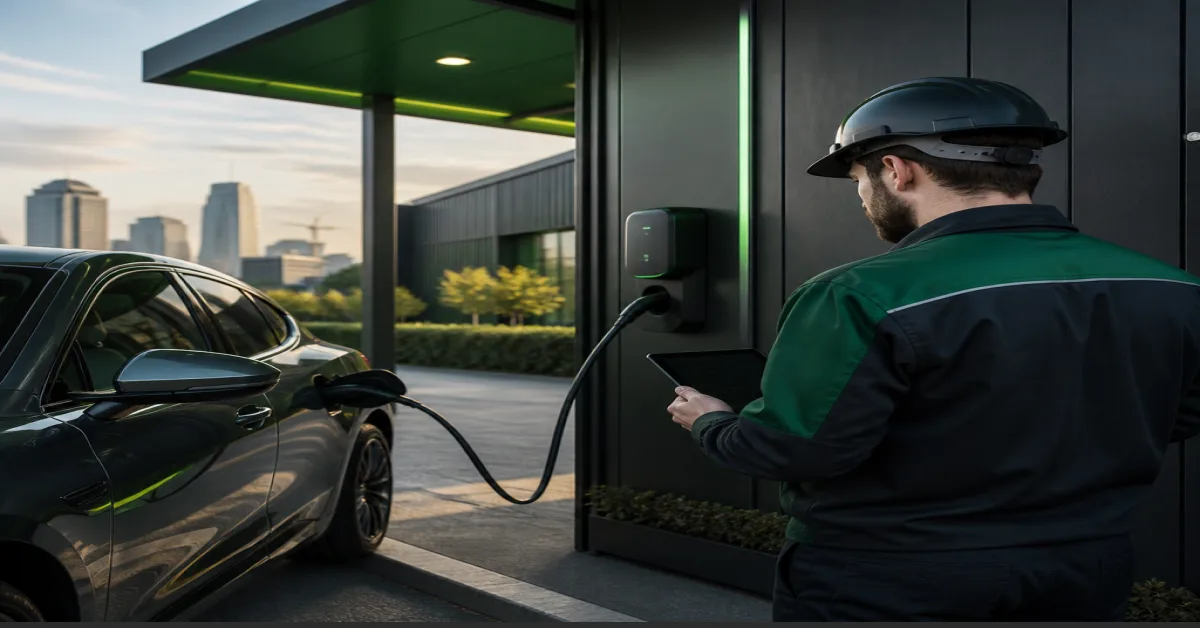
EV Charger Installation Manchester | Bee Solar
Commercial EV chargers with DNO notification handled. Survey, install and maintenance included.
What's Covered on This Page
- What EV Charger Installation in Greater Manchester Actually Involves
- Victorian and Terraced Homes: Earthing, Voltage Drop, and Why a Site Survey Comes First
- Home Charging vs Workplace and Commercial EV Charging
- Conservation Areas, Listed Buildings, and Manchester Planning Checks
- Smart Charging, Tariffs, and Solar-Ready Configuration
- Cost Drivers, Competence, and When Not to Choose the Fastest Quote
- Frequently Asked Questions
- Get a Free EV Charger Site Survey in Manchester
Need EV Charger Installation Manchester?
0161 570 0596
Get A Free Quote. Bee Solar is ready to help.
What EV Charger Installation in Greater Manchester Actually Involves
EV charger installation in Manchester is a surveyed electrical project whose visible wall unit is the end result, not the whole job, and Greater Manchester and UK electrical regulations apply (not US Manchester). Bee Solar provides residential and commercial EV charging installation across Manchester, with NICEIC-accredited engineers who manage the survey, electrical work, cabling, commissioning, and DNO notification.
Confirm Location
Confirm the charger location based on parking layout, cable routing, and proximity to the electrical supply.
Consumer Unit Check
Upgrade or modify the consumer unit if the existing setup cannot safely handle the additional load.
Armoured Cabling
Run armoured cabling from the distribution board to the mounting point, buried in ducting or surface-mounted as the building requires.
Mount & Configure
Mount, wire, and configure the charge unit for the property's specific requirements.
Test & Commission
Test the full circuit, verify earth-fault protection, commission the unit, and issue a completion certificate.
DNO Notification Included
Any installation above 3.68 kW single-phase requires DNO notification – submitted as standard.
Any installation above 3.68 kW single-phase requires DNO notification to the local distribution network operator. Bee Solar submits this as a standard part of the job; it is not optional. Commercial sites that need a full supply upgrade require a formal DNO application, which is a distinct process from notification.
Cable-run logistics dominate installation time. A warehouse in Trafford Park might need a 40-metre trench across a car park, while an office block might only need 5 metres of surface trunking. The survey defines the job, because every site differs. Common catch-outs on older Manchester commercial stock include undersized supplies and consumer units from the 1990s, and Bee Solar flags these extras before install day rather than discovering them mid-job. Each stage exists for a reason: capacity planning prevents tripping, correct cabling prevents voltage drop, earth-fault protection keeps the unit safe, and legal notification keeps the installation compliant.
A quote without a site survey is incomplete on older stock. Request a free, no-obligation survey to confirm the exact work your property needs before any drilling starts.
Victorian and Terraced Homes: Earthing, Voltage Drop, and Why a Site Survey Comes First
Victorian and terraced Manchester properties routinely need a pre-install survey because consumer units, patched wiring, and earthing arrangements may not support a 7 kW charger without upgrades. The electrical infrastructure in these homes, common across Chorlton, Didsbury, Levenshulme, and the city-centre fringe, determines whether a charger can be fitted safely, not the age of the building itself. For owners of these older properties, it's also worth considering how a free home insulation survey can complement your energy efficiency upgrades. Furthermore, many owners of these properties explore solid wall insulation for period properties as a way to reduce overall energy demand before adding an EV charger.
Terrace constraints are specific and predictable. Many have no driveway, the fuse board sits at the rear of the property, and the cable run to a front-mounted charger can exceed 15 metres. Voltage drop increases with run length, so the design may require a larger cable cross-sectional area or a different route rather than a standard DIY cable. This is a terrace design problem, not a generic coverage claim: the rear board and long front run dictate the cable specification before anything is mounted.
A 45-minute site survey for these properties checks the following:
- Consumer unit condition and capacity for the additional load
- Earthing type and whether it needs upgrading to meet current regulations
- Cable routing options that avoid listed-building restrictions or shared walls
- Wi-Fi signal strength at the charger location for smart functionality
- Whether DNO notification or application is required for the additional load
- Photographs and a documented route so extra electrical work is flagged before install day
Properties in areas like Levenshulme with rear shared access lanes change where the charger can be mounted and how the supply is routed, which is impossible to assess from a phone call. Adult access, landlord or freeholder written permission, and shared electrical supplies are early objections that need resolving before the survey. Most homes do not need extra work, but confirming this first prevents costly rework and keeps the installation compliant from day one.
Home Charging vs Workplace and Commercial EV Charging
A home charger serving one vehicle overnight is not the same specification as commercial or workplace charging for multiple vehicles at once. Bee Solar installs both, but the electrical design, supply requirements, and software needs differ substantially. For business owners, exploring solar for commercial premises can be a key part of the energy strategy. Additionally, understanding broader renewable energy procurement options like PPAs is essential for long-term sustainability planning.
| Factor | Home Charging | Workplace / Commercial Charging |
|---|---|---|
| Supply / phase | Single-phase domestic supply | Three-phase common on commercial premises |
| Concurrency | One vehicle, one driver, overnight | Multiple vehicles charging simultaneously, often in tight return windows |
| Software | Basic scheduling via app | Billing, access control, usage reporting per connector |
| DNO scale | Notification for >3.68 kW single-phase | Formal DNO application when existing capacity is insufficient |
| Typical site | Driveway or off-street parking at home | Depots, office car parks, warehouses, fleet bases |
Commercial sites face a failure mode that home overnight charging never reveals: simultaneity. Delivery fleets returning to a Trafford Park depot at 5 pm all needing a full charge by 6 am, or staff cars at an office near Spinningfields requiring top-up during a seven-hour shift, create concurrent electrical demand that a domestic-grade unit cannot handle. Load management systems prevent the building supply from tripping when multiple vehicles plug in at once, and back-office software handles billing and access control.
Do not use a domestic-grade unit at a warehouse or multi-bay site. The result is queues, unready vehicles, and rework that costs more than doing the job properly once. Commercial solar pairing is also available as configuration and future-proofing, where a roof already generates power or solar is planned. Capital allowances and salary sacrifice schemes are general UK possibilities worth confirming with a tax adviser, not guarantees from Bee Solar.
Home: Single Vehicle
Single-phase overnight charging with basic app scheduling for driveways.
Workplace: Multi-Bay
Three-phase supply with load management to prevent tripping at peak.
Billing & Access
Back-office software for billing, access control and per-connector reporting.
Conservation Areas, Listed Buildings, and Manchester Planning Checks
Most EV charger installations may fall under permitted development, but conservation areas and listed buildings change the rules, and assuming exemption is a common mistake. Bee Solar checks planning status at survey stage for every Manchester property, because drilling into a heritage façade without the right consent can lead to enforcement and removal at the owner's expense.
Planning checks are triggered by any of the following:
- Property within a designated conservation area such as Castlefield, Ancoats, or Stevenson Square
- Grade I, Grade II*, or Grade II listed status on the building
- Charger location facing a public highway or prominent elevation
- External trunking visible from the street
- A neighbouring listed structure, which can trigger additional scrutiny even when the subject property is unlisted, a common catch in the Northern Quarter and around Whitworth Street and St Ann's Square
Permitted development covers most wall-mounted and ground-mounted chargers outside conservation areas up to certain size thresholds. Heritage sites may require listed building consent or a planning application, which Bee Solar confirms and handles through liaison with Manchester City Council's planning department. Planning confirmation takes about a day; skipping it can cost months of enforcement headaches, so checks are built into every project timeline before any drilling begins. For domestic terraces, visible trunking and listed elevations are checked before work, not after.
Smart Charging, Tariffs, and Solar-Ready Configuration
Smart charging is software and configuration that controls when chargers draw power, not a default claim about extra green hardware. Bee Solar configures charging systems during commissioning so they deliver operational value from day one.
Off-Peak Scheduling
Scheduled off-peak charging and tariff alignment set up during commissioning to avoid demand spikes.
Load Balancing
Load balancing across multiple charge points with real-time monitoring and usage reporting.
Solar-Ready
Solar-first integration where PV already exists, designed solar-ready if PV is planned.
Tariff alignment is set up during commissioning, so chargers pull energy during off-peak windows and throttle back when demand charges spike under a fixed business energy contract. Flexible contracts open up half-hour slot chasing. Claims about specific percentage savings on charging costs should be treated cautiously unless independently verified for the site's actual tariff and usage pattern.
Future-proofing at install stage matters because retrofitting solar-ready capability or load management later can mean rewiring and additional DNO applications. Specifying this at first install is the cheaper compliance path. If PV is planned, Bee Solar designs the charging infrastructure to be solar-ready from the start. Retrofitting later is not just a hardware swap; it can trigger extra DNO work that doubles the cost of getting it right the second time. To maximise the benefits of solar-ready systems, it's wise to factor in long-term maintenance considerations for all your equipment. Additionally, improving your property's thermal efficiency with loft insulation services in Manchester can reduce overall energy consumption and complement your EV charging setup.
Cost Drivers, Competence, and When Not to Choose the Fastest Quote
Cost is driven by run length, consumer unit and earthing upgrades, groundworks, three-phase or load-management requirements, and DNO upgrade scale, not by a published average that can be quoted without seeing the site. A cheap or fast quote that skips the survey on a Victorian board or a long terrace run is incomplete, not a bargain. When evaluating installers, reviewing our team's experience can provide the confidence needed to choose a specialist.
EV charging is not a DIY job for typical chargepoints. It is specialised electrical work that falls under Part P competent-person rules, with mandatory DNO notification above 3.68 kW single-phase. A "normal electrician" without EV-specific experience may miss earthing requirements, voltage-drop calculations, or the DNO paperwork that keeps an installation legal. A specialist assesses the whole system, not just the wall box.
Common mistakes that drive up cost or cause failure include:
- Quoting without seeing rear lanes or cable-run routes
- Skipping DNO notification or application
- Bolting chargers onto listed façades without consent
- Assuming a home unit scales to a warehouse or multi-bay depot
A survey-first enquiry path costs nothing and prevents the most expensive outcome: an installation that does not work, is non-compliant, or needs redoing. Bee Solar quotes after survey so the price reflects the actual site, not a directory average. An adult must be on site for the install, and no reputable installer should claim every job is quick when older boards and long runs change the timeline.
Frequently Asked Questions
Common Questions About EV Charger Installation in Manchester
Do I need permission from my landlord or building owner before getting an EV charger installed in Manchester?
Yes, you need written permission from your landlord or freeholder before any installation work begins. This applies to flats, terraced rentals, and leasehold properties across Manchester. Some buildings also have shared electrical supplies, which means your landlord needs to confirm the supply can handle the extra load. Sorting this out before your survey saves everyone time.
How long does a home EV charger installation take on the day?
Most home installations take between two and four hours once the survey is done and parts are confirmed. Straightforward jobs with short cable runs, a modern consumer unit, and a clear mounting point sit at the lower end. Older properties in areas like Chorlton or Levenshulme with longer cable runs or consumer unit upgrades take longer. Bee Solar tells you exactly what to expect after the survey, so there are no surprises on the day.
My Manchester home is a Victorian terrace with no driveway. Can I still get a charger installed?
Yes, many Victorian terraces in Manchester can still have a charger fitted, but the setup needs more planning. Rear-access properties, shared lanes, and front-facing street parking all change how the cable is routed and where the unit is mounted. Cable runs of 15 metres or more are common in these homes. Earthing, consumer unit condition, and routing options are assessed during the survey. It is very doable, it just needs the right approach from the start.
What electrical work might be needed before my charger can be installed?
Some properties need consumer unit upgrades or earthing improvements before a charger can be safely connected. This is especially common in older Manchester homes where wiring has been patched over the years. A 7 kW charger puts real demand on the supply. If the board cannot handle it, this is flagged during the survey and explained before any work begins. Most homes do not need extra work, but knowing before install day keeps everything on track.
Does someone need to be home during the installation?
Yes, an adult needs to be present for the full installation. Access is needed to the consumer unit, the mounting location, and the cable route throughout the job. Bee Solar also walks you through the finished installation before leaving, showing you how to use the unit and handing over the completion certificate. The whole visit is usually done within half a day for a standard home install in Manchester.
Do you handle the DNO notification as part of the installation?
Yes, Bee Solar handles the DNO notification for you. Any charger above 3.68 kW single-phase requires notification to the local distribution network operator, and it is not optional. This is submitted as part of the job so you do not have to chase paperwork or worry about compliance. Commercial sites in Manchester that need a full supply upgrade may also need a formal DNO application, which Bee Solar manages from start to finish.
Can I install my own EV charger in the UK?
No, a typical EV charger installation is not a DIY job. It is specialised electrical work that falls under Part P competent-person rules, and DNO notification is mandatory for installations above 3.68 kW single-phase. Earthing requirements, voltage-drop calculations, and circuit protection all need to be designed and verified by someone with the right competence.
Can a normal electrician install an EV charger, or do I need a specialist?
A normal electrician may be able to do the physical connection, but EV charging is specialised electrical work. A specialist understands earthing arrangements on older properties, voltage-drop calculations on long cable runs, smart charger configuration, and the DNO notification process. Bee Solar's NICEIC-accredited engineers assess all of this before work begins so the installation is compliant and performs correctly.
What factors affect the cost of EV charger installation in Manchester?
Cost is driven by cable run length, consumer unit condition, earthing upgrade requirements, groundworks or trenching, three-phase or load-management needs, and the scale of any DNO upgrade. A short run to a modern consumer unit costs less than a 40-metre trench across a Trafford Park car park or a 15-metre run from a rear fuse board in a Levenshulme terrace. A survey confirms which factors apply to your property before any quote is given.
Do conservation areas or listed buildings in Manchester need extra planning checks?
Yes, conservation areas and listed buildings change the permitted-development rules. Grade I, Grade II*, or Grade II listing, a charger facing a public highway, external trunking visible from the street, or a neighbouring listed structure can all trigger listed building consent or a planning application. Bee Solar confirms this at survey stage and handles the liaison with Manchester City Council's planning department.
Get a Free EV Charger Site Survey in Manchester
Request a free, no-obligation site survey to confirm what your Manchester property needs for EV charging. Bee Solar covers the survey, DNO notification, and the full installation process from consumer unit assessment to commissioning. Call 0161 570 0596 or request a quote online to discuss your home or commercial project. You can also contact Manchester Wall Insulation directly for more information on how we can assist with your energy efficiency needs.
Get Your Free EV Charger Quote
Our engineers will visit your site for a free survey and deliver a detailed proposal within 48 hours.
0161 570 0596
No obligation. Response within 24 hours.