
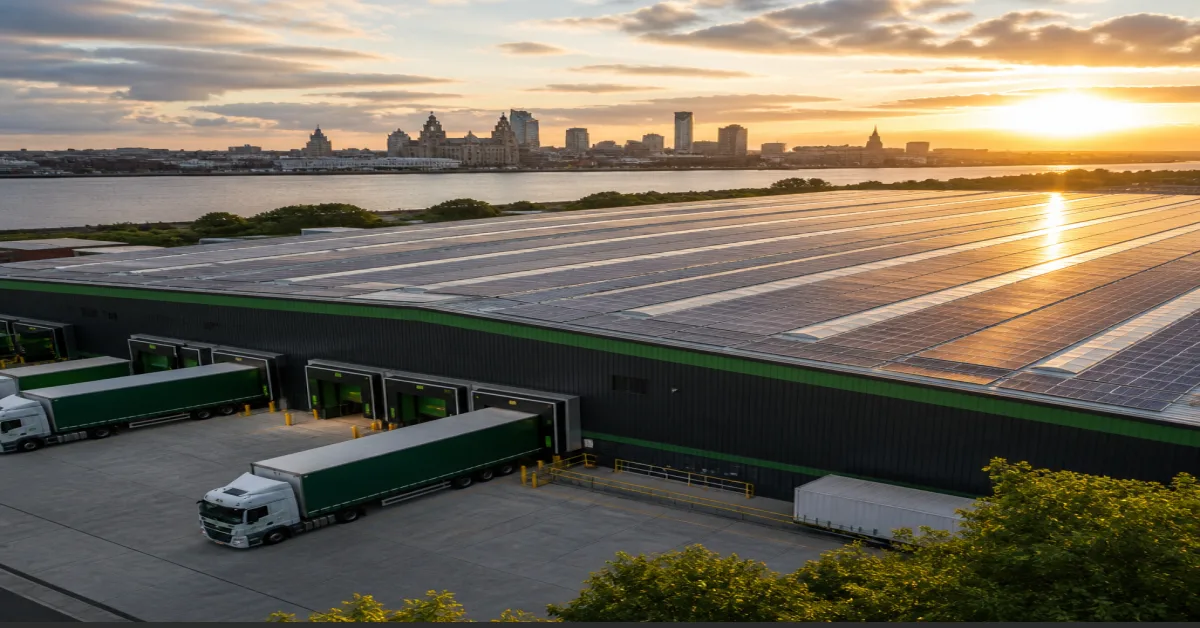
Commercial Solar Installation Liverpool | 250 kWp Case Study
See how Bee Solar delivered a 250 kWp warehouse solar installation in Liverpool, reducing annual energy bills by £58,000 for Mersey Logistics Ltd.
Client
Mersey Logistics Ltd
Location
Liverpool, Merseyside
System Size
250 kWp / 4,200 m²
Completed
2024
Liverpool Warehouse Solar at 250 kWp: What This 2024 Project Proves
Bee Solar completed a 250 kWp rooftop array covering 4,200 m² for Mersey Logistics Ltd in Liverpool, Merseyside, in 2024. This commercial solar installation in Liverpool cut the facility's electricity bill by 32% (£58,000 per year) on a site that previously spent over £180,000 annually on power, while offsetting 85% of daytime electricity demand.
Bee Solar is a Greater Manchester provider that delivers to Liverpool sites. Enquiry via 0161 570 0596.
Who this is for: Operations managers and owners of large warehouses and distribution centres in the North West with high daytime electricity loads. This is warehouse-class 250 kWp work, not a 5 to 11 panel domestic package. The next step is a free site survey, not a product selection. That this site proved viable adds to the current drivers of commercial solar demand for distribution operations. The value of this case is that it proves a 24-hour distribution operation in Merseyside can host a large rooftop array without stopping work — and that the financial case can be quantified. For operators exploring this path, the sector-specific considerations for solar for warehouse roofs are covered in detail on our warehouse hub.
Figures shown are this facility's 2024 results, not a guarantee for every Liverpool roof. Many Liverpool search results mix domestic packages into commercial queries; this page is specifically about warehouse-scale generation for 24-hour logistics.
- This project is: A 250 kWp warehouse array for Mersey Logistics Ltd, Liverpool 2024.
- This project is not: A 5 to 11 panel domestic package or guaranteed savings for every roof.
- Provider: Bee Solar, Manchester base delivering to Liverpool. Next step: free site survey or 0161 570 0596.
The Challenge: Ageing Warehouse Roof Load and 24-Hour Operational Continuity
Mersey Logistics Ltd's 24-hour distribution centre faced energy costs exceeding £180,000 annually, the roof required structural reinforcement assessment because of age, and continuity could not be disrupted during a three-phase installation.
Installing across a live 24-hour roof in one hit is the common mistake on warehouse projects. Load analysis and phased night work are the decision gate for sites like this, not a benefit slogan. If an installer cannot explain how they will phase the work around your operations, they have not planned for a distribution centre — they have planned for an empty building.
Four factors resolved first
- Roof age and condition: Full condition assessment for additional load.
- Structural load analysis: Confirmed capacity for 250 kWp across 4,200 m².
- 24-hour operations: No full-roof shutdown around live logistics.
- Three-section programme: Work in maintenance shutdowns and night-shift windows.
The Solution: Structural Analysis, Three-Section Phasing, and Tier 1 Panels
Bee Solar conducted a structural load analysis and coordinated phased installation across three roof sections, completing work during scheduled maintenance shutdowns, with night-shift installation phases to keep disruption minimal.
Design priority: Sized to offset 85% of daytime demand first, with Smart Export Guarantee for surplus only. Export income is secondary to self-consumption. The regulatory framework for a connection of this size involves specific paperwork, so understanding G99 and G100 applications is part of the groundwork.
Survey
Roof condition and electrical assessment before any panel layout is fixed.
Load analysis
Engineering confirmation the ageing roof can carry 250 kWp across 4,200 m².
Phased install
Three roof sections completed in shutdowns and night-shift windows.
Tier 1 panels
25-year warranty panels selected for north-west yield. See selecting the right solar panels.
Process was kept simple: survey, load analysis, then phased programme around operations. Completed 2024 — structure and operations before panel layout.
Project Results: Bill Reduction, Payback, CO2e, and SEG Income
Annual electricity bill reduced by £58,000 (32%), with a projected payback period of 3.8 years. Baseline was over £180,000 per year. To understand the financial mechanics, explore how commercial solar savings work.
Annual savings: £58,000 (32%) with 3.8-year payback
Daytime demand offset: 85% self-consumption first
SEG income: £4,200 per year plus 78 tonnes CO2e cut
| Project Metric | Result |
|---|---|
| System size | 250 kWp |
| Roof area | 4,200 m² |
| Completed | 2024 |
| Baseline electricity cost | Over £180,000 per year |
| Annual savings | £58,000 (32%) |
| Payback period | 3.8 years |
| Daytime demand offset | 85% |
| SEG surplus income | £4,200 per year |
| Carbon reduction | 78 tonnes CO2e per year |
| Operational disruption | Minimal via night-shift phases |
SEG at £4,200 is ~7% of total benefit — useful residual, not the reason for approval. These are this project's results, not a promise for every Liverpool warehouse.
Who This Liverpool Commercial Solar Service Is For — and How to Compare Installers
Proof of warehouse-class commercial solar installation in Liverpool, not a domestic package. For operations with fleet, integrate EV charging infrastructure alongside solar. Demand profiles like this align well with generation, as seen in this similar-scale cold storage project.
Good fit
- Large warehouses / DCs in North West with high daytime load.
- 3PL, manufacturing, cold storage, e-commerce fulfilment.
- Need structural assessment + phased work around live ops.
- Wanting self-consumption first, owned-system economics.
Not a fit
- Seeking 5 to 11 panel domestic package pricing.
- Expecting quote for 250 kWp from a phone call, no survey.
- Wanting export-led system sized for SEG not self-use.
- Roof unable to pass load checks without redesign.
Capex vs fully funded
This case is owned-system economics, 3.8-year payback. Fully funded trades ownership and savings for zero upfront cost. A survey can model both.
How to compare installers
- Named kWp, client, date, structural method, phasing plan, Tier 1 warranties. Check our track record in commercial solar.
Want results like this? Every project starts with a free site survey. Start Your Project. 0161 570 0596.
Process Overview
From free site survey to phased install and SEG registration.
Free site survey
Assess roof area, condition and daytime demand.
Load analysis
Engineering sign-off for 250 kWp weight.
Phased programme
Three sections in shutdown and night windows.
Installation
Tier 1 panels installed with minimal disruption.
SEG & handover
Registered for surplus, prioritising self-use.
Frequently Asked Questions
How much does commercial solar installation in Liverpool cost for a warehouse?
Cost is site-specific and depends on roof area, structural condition, system size, and electrical infrastructure. This project's results provide the reference point: 250 kWp delivered a £58,000 annual saving and a 3.8-year payback. That payback period implies the installed cost was in the region of £220,000, but every roof and electrical setup differs. A free site survey is required to model your building's actual cost and return; no credible installer quotes a 250 kWp warehouse from a phone call alone.
Can you install commercial solar on a 24-hour distribution centre without stopping operations?
Yes. The Mersey Logistics Ltd project used a three-section phased installation, completing work during scheduled maintenance shutdowns and night-shift windows. Load analysis and a phased programme around live operations are the required method for 24-hour sites. Any installer who proposes closing a live DC for the duration of a three-phase installation has not planned for distribution operations.
Do warehouse roofs in Liverpool need structural reinforcement before solar?
Many do, particularly older roofs built to lighter loading standards. A structural load analysis is mandatory before installation to confirm the roof can carry the additional weight of panels and mounting systems. Roofs that fail load checks need reinforcement or redesign before any panel is fixed. The age and condition of the Mersey Logistics Ltd roof was one of the primary challenge factors in this project; it was resolved through engineering assessment before installation began.
What is the Smart Export Guarantee for a commercial solar system, and is export the main saving?
The Smart Export Guarantee pays businesses for surplus electricity sold back to the grid at a rate set by their chosen supplier. Export is secondary to self-consumption. The Mersey Logistics Ltd system offsets 85% of daytime demand first; SEG surplus income of £4,200 per year is residual revenue on top of the £58,000 bill reduction. If a proposal leads with export income as the headline financial benefit, the system is likely sized incorrectly for a daytime-heavy warehouse.
Should a North West warehouse buy a solar array or look at fully funded / zero-upfront offers?
Buying gives you asset ownership and the full payback, as in this 3.8-year case. Fully funded offers remove upfront cost but typically trade away some or all of the savings and asset value, with the provider owning the generation and selling you power at an agreed rate. For a facility spending over £180,000 per year on electricity, ownership delivers the full £58,000 annual reduction. A survey can model both paths for your site without committing you to either.
Are domestic solar packages suitable for a 250 kWp commercial warehouse?
No. Domestic packages are sized for household roofs and typical home consumption, and their pricing models assume 2 to 4 kWp installations. A 250 kWp warehouse array covering 4,200 m² requires structural analysis, three-phase electrical work, and a phased installation programme. The wrong package class will not meet a distribution centre's demand or fit its roof. This is why the SERP is crowded with domestic prices that have no bearing on warehouse projects — the engineering and commercial cases are fundamentally different.
What results did the Mersey Logistics Ltd 250 kWp Liverpool array actually deliver?
The 2024 installation reduced annual electricity bills by £58,000 (32%), achieved a projected 3.8-year payback, offset 85% of daytime demand, generated £4,200 per year in SEG surplus income, and cut carbon emissions by 78 tonnes CO2e per year. Operational disruption was minimal through night-shift phasing. The client was spending over £180,000 per year before installation, so the savings are measured against a verifiable baseline.
What are the 20% and 33% solar rules for UK commercial roofs?
Those percentages are not defined in this project's data and should not be treated as fixed planning or design rules. They appear in some industry discussion around roof coverage ratios but are not universal thresholds. Commercial warehouse solar design turns on structure, operations, and demand match — not a percentage shortcut. A site survey and load analysis determine what is possible for your roof, and the daytime demand profile determines what is worth installing.
Who is Bee Solar's commercial solar installation in Liverpool for?
It is for operations managers and owners of large warehouses and distribution centres in the North West with high daytime electricity loads. The service covers structural assessment, phased installation around live operations, and systems sized for self-consumption first, not domestic packages. If you run a 24-hour DC in Liverpool, Knowsley, Warrington, Widnes, or across Merseyside, this service is aimed at your site class.
How do I book a free site survey for warehouse solar in Liverpool or the North West?
Call 0161 570 0596 or start your project through the Bee Solar website. Every project begins with a free site survey to assess roof structure, daytime demand, and system sizing before any commitment. The survey covers roof condition, load capacity, electrical infrastructure, and operational scheduling so you receive a phasing plan you can actually execute around your logistics calendar.
Want Results Like This?
Every project starts with a free site survey. Let us show you what solar can do for your building.